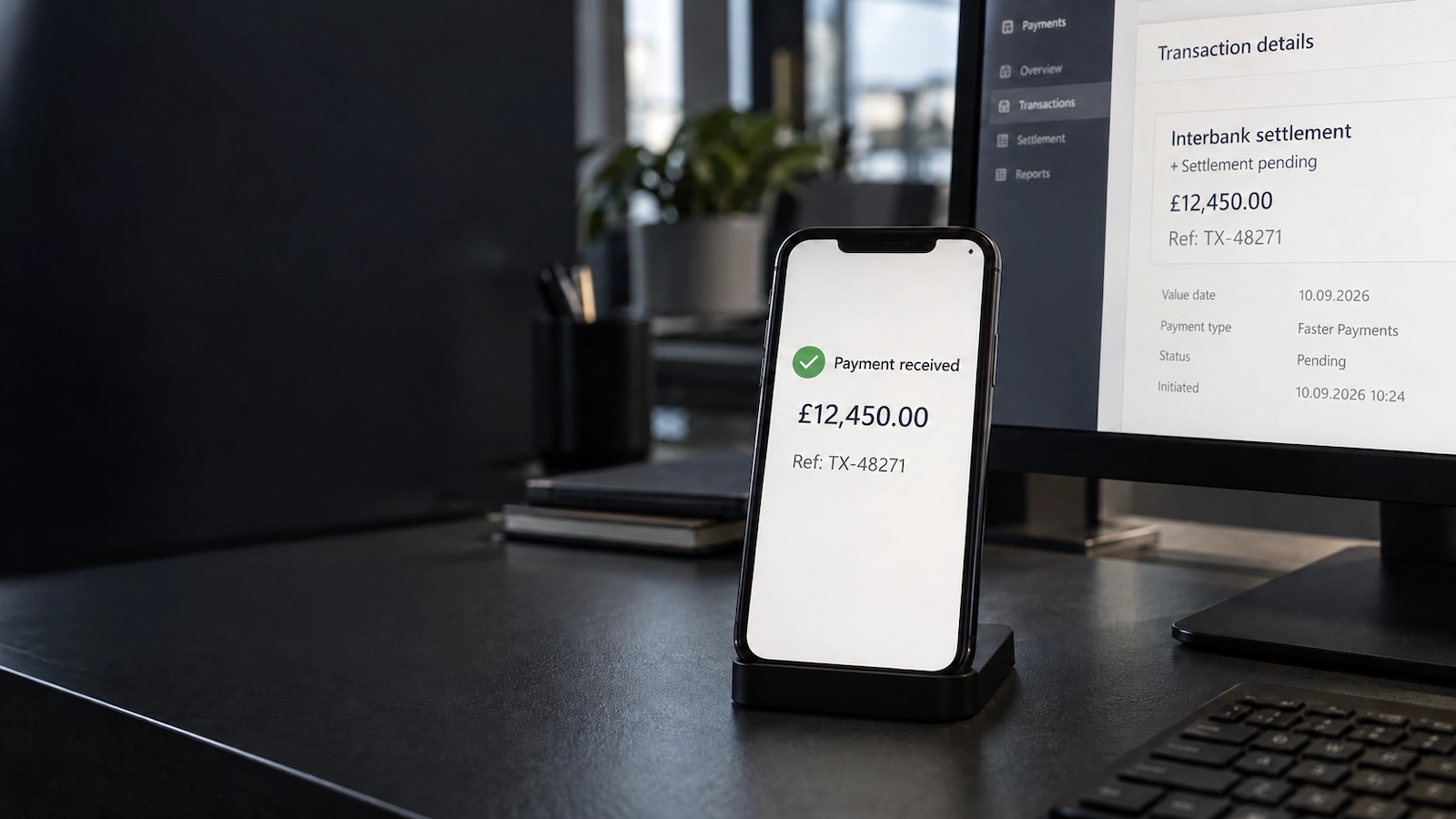
The four states and the codes that report them
Principle 8 of the CPMI-IOSCO Principles for Financial Market Infrastructures defines final settlement as the irrevocable and unconditional transfer of an asset or discharge of an obligation. It requires an infrastructure’s rules to fix two separate points: the point at which settlement becomes irrevocable and unconditional, and the earlier point after which a participant can no longer revoke an unsettled instruction. Between those points an instruction is accepted, irrevocable by its sender and still unsettled. That is the stage of the payment lifecycle most status screens show as “processing”.
Status between institutions travels as ISO 20022 codes in pacs.002 status reports. RCVD: the instruction has been received. ACTC: technical validation passed. ACCP: customer-profile checks passed. ACSP: the instruction “has been accepted for execution”. None of these moves money. ACSC reports that settlement has completed, and the code set warns that the status is “provided for transaction status reasons, not for financial information” and is usable “only after bilateral agreement”. ACCC, registered at Swift’s request for correspondent chains, is the only code that states the creditor’s account has been credited. ACWP, registered for The Clearing House’s RTP network, marks a payment the receiving bank has accepted but holds from its customer for regulatory or fraud screening. BLCK marks an ACWP payment that is blocked: “neither posted to the Creditor’s account, nor returned to the Debtor”.
Since 22 November 2025, when Swift ended the coexistence of MT and ISO 20022 messages for cross-border payment instructions, these codes carry the status of correspondent payments as well as instant and RTGS payments. A pacs.002 is one agent’s report on its own step in the message chain. It posts nothing to any ledger and says nothing about the funds at any other agent.
Where each rail leaves the credit conditional
Checks: available before final
Regulation CC fixes when a check deposit must be available. From 1 July 2025 the first $275 must be available by the next business day; the exception hold for large deposits starts at $6,725. Final payment is fixed separately. Under UCC section 4-215 an item is finally paid only when the payor bank settles without a right to revoke, or fails to revoke a provisional settlement in time. Until then every credit in the collection chain is provisional: “if provisional settlement for an item does not become final, the item is not finally paid”. The depositary bank that released $275 under Regulation CC holds a credit it may still have to charge back under the UCC.
ACH: available on the settlement date, subject to return
Nacha’s Operating Rules require an RDFI to make a non-Same Day credit entry available for withdrawal by 9:00 a.m. local time on the Settlement Date; from 18 September 2026 the deadline applies without the earlier condition that the entry reached the RDFI by 5:00 p.m. the day before. The obligation is “subject to its right to return the Entry”, and an RDFI that reasonably suspects a credit is unauthorized is exempt from it. That right runs two banking days: the return must be made available to the ODFI by the opening of business on the second Banking Day following the Settlement Date. Availability precedes the close of the return window by two banking days.
FedNow and RTP: settled in central bank money, not yet accepted
Under subpart C of Regulation J, payment by a Reserve Bank to a receiving bank over the FedNow Service is final at the earlier of the credit to its settlement account or the sending of the payment order. A beneficiary’s bank that accepts must pay the beneficiary “immediately after its acceptance”. Section 210.44(b)(3) separates the two moments. A beneficiary’s bank with reasonable cause to believe the beneficiary is not entitled or permitted to receive payment may notify its Reserve Bank that it needs additional time; it then “does not accept the payment order upon its receipt of payment”. FedNow settles the transaction regardless, and the Reserve Banks cannot cancel it. The Receiver FI must report a status by midnight Eastern Standard Time on the next business day: posted; rejected, with a return; or blocked, with funds “not posted to the receiver nor returned to the sender”. “Pending” is allowed past the deadline only while the concern persists. Interbank money is final in seconds. The customer’s credit is conditional for up to a business day and, if blocked, indefinitely. A Board of Governors proposal of 10 April 2026 would carry the same structure across a border: participants could route the domestic leg of a cross-border payment through an intermediary other than a Reserve Bank, with the immediate-availability duty applying only where the beneficiary’s bank itself accepts over FedNow, so a beneficiary abroad would hold a payment that is final in the United States and carries no Regulation J availability right. Comments closed on 9 June 2026.
Under the RTP Operating Rules, settlement is complete when the RTP System has recorded the decrease in the sending participant’s net position and the increase in the receiving participant’s net position, and that completion “constitutes final settlement” of the payment. The receipt of an “accept” or an “accept without posting” message and the recording of those entries are deemed simultaneous. An RTP credit that the receiving participant holds from its customer under accept-without-posting is therefore already final between the participants, in the same position as a FedNow credit under ACWP; what remains open is the receiving participant’s own decision on the customer’s credit.
SCT Inst: the 5-, 7-, 9- and 10-second rules
The 2025 SEPA Instant Credit Transfer Rulebook, effective 5 October 2025, cut the target maximum execution time from 10 to 5 seconds and the hard time-out from 20 to 7, both measured from the Originator PSP’s time stamp. The Beneficiary PSP’s clearing and settlement mechanism must hold a positive or negative confirmation by the 7th second; the confirmation must reach the Originator PSP by the 9th. The Beneficiary PSP makes funds available only once it is certain its positive confirmation reached its CSM. The CSM then settles; in TIPS the order is entered and irrevocable, for the purposes of the Settlement Finality Directive, when the paying participant’s account is debited.
At the 10th second with no confirmation, the rulebook tells the Originator PSP to lift the reservation on the originator’s account — and, in the same section, to “maintain settlement certainty” toward the Beneficiary PSP, because it “cannot consider that the processing of the SCT Inst Transaction has failed until it has received a confirmation message reporting the failure”. A positive confirmation arriving later is a “belated successful execution”: the originator has been told the payment did not happen, the beneficiary has the money, and section 5.9 with Annex III places the exposure on the Originator PSP. After settlement the routes back are a Recall — 10 Banking Business Days for duplicates and technical errors, 13 months for fraud, answered within 15 Banking Business Days and, where national law requires, only with the beneficiary’s authorisation — or a Request for Recall by the Originator, which “does not guarantee” a return.
Regulation (EU) 2024/886 amended Article 2 of the Settlement Finality Directive so that payment institutions and e-money institutions qualify as participants in designated systems, with transposition due by 9 April 2025. The ECB opened T2 and TIPS to non-bank PSPs meeting the TARGET Guideline requirements from October 2025. The finality described above now protects non-bank PSPs holding their own TIPS accounts.
Correspondent chains and interlinked systems: credit pending
In a correspondent chain ACSP carries a reason code registered from Swift gpi practice. G000 and G001: the payment moved to the next agent, tracked or untracked. G002: the credit “may not be confirmed same day”. G003: the credit is “pending documents or additional information”. G004: the credit is “pending funds” — the cover has not arrived. A beneficiary bank that credits its customer on G004 is lending to its correspondent until the cover leg settles; the correspondent chain has stalled, not failed. Nexus, the scheme designed at the BIS Innovation Hub for linking domestic instant payment systems, carries the same distinction across borders: for non-time-critical payments ACWP means the funds reached the destination PSP without being credited to the recipient, and the source PSP must tell the sender the payment is still being processed.
Deferred net settlement: credited before settled
Faster Payments makes the payee’s funds available around the clock. The interbank obligations settle on a multilateral net basis in the Bank of England’s RTGS in cycles during the business day — the deferred net model it shares with Bacs and the card schemes. The Bank’s own description: “in the periods between settlement cycles, potential settlement risk can therefore arise between settlement participants”; prefunding held in RTGS “caps the maximum net obligations”, so a participant’s default cannot unwind what has been credited. The system is designated under the UK Settlement Finality Regulations, and transfers past the defined processing point survive a participant’s insolvency. Availability precedes settlement by hours; the exposure in between is covered by the prefunding, not by the payment.
Conditional by design: synchronised settlement
The Bank of England’s synchronisation service, set out in its May 2026 consultation on near-24×7 settlement, will allow “conditional settlement of funds in RTGS against assets on a variety of external asset ledgers”: “the funds will settle if and only if the asset also settles”. A Synchronisation Lab with 18 selected organizations opened in May 2026 on RT2, live since April 2025. Project Meridian FX, reported by the BIS Innovation Hub and five central banks on 24 April 2025, used a synchronisation operator to settle payment-versus-payment FX atomically between an emulated UK RTGS and three Eurosystem interoperability solutions. The Eurosystem’s Pontes track, approved on 1 July 2025, scheduled a pilot link between DLT platforms and TARGET Services for the end of the third quarter of 2026.
In each of these the condition is checked before either leg settles. Nothing moves while it is open, so no party holds a credit that another can take back — the reverse of every state in the previous section. The CPMI-IOSCO guidance of 13 July 2022 applies the same test to systemically important stablecoin arrangements and identifies probabilistic settlement — a technical reversal remaining possible after the defined point — as a friction with a legally defined moment of finality.
What can be relied on at each state
| State, in the source’s own term | What has happened | Who can still take it back | What the record has to show |
|---|---|---|---|
| Received — RCVD, ACTC | Instruction received and validated; no obligation created | The sender, by cancellation; any agent, by RJCT | Message identifier and time stamp — in SCT Inst the time stamp starts the 5/7/9/10-second clock |
| Cleared, accepted for execution — ACCP, ACSP; SCT Inst positive confirmation; FedNow ACTC | Checks passed, obligations determined; funds not yet moved | A scheme time-out or an upstream reject; in a correspondent chain, G002–G004 hold the credit open | The confirmation with its reason code, and the deadline by which silence counts as an open state rather than a failure |
| Settled — ACSC; Regulation J §210.31 or §210.46 credit; TIPS account debit; RTP net-position record | Interbank obligation discharged in the settlement asset; irrevocable by the sending bank; protected against insolvency in a designated system | No one, through the system; a claim for restitution of a mistaken payment remains outside it | The infrastructure’s own settlement confirmation, reconciled to the ledger posting — not an agent’s ACSC |
| Available, not final — Regulation CC check credit; ACH credit before final settlement; Faster Payments credit before the settlement cycle | Customer may use the funds; the credit is provisional | The depositary bank or RDFI, by charge-back on return; in Faster Payments the interbank exposure is covered by prefunding | Availability date, any hold notice, and the return window still open |
| Settled, not posted — FedNow and RTP ACWP; Nexus ACWP; ACSP with G003 or G004 | Interbank money final; the beneficiary’s bank has not accepted for its customer | The beneficiary’s bank: post, return or block — in FedNow by midnight Eastern Standard Time on the next business day | The pacs.002 status, the deadline, and the final status when it arrives |
| Final and posted — ACCC; posting after a final settlement | Irrevocable and unconditional; customer credited | Only with the beneficiary’s consent (SCT Inst Recall, Request for Recall by the Originator) or by a court | The posting entry and the rulebook’s finality point it followed |
The cost of reading it wrong
On 11 August 2020 Citibank, as administrative agent on a Revlon loan, wired $893,944,008.52 to 315 noteholders when it meant to pay interest. Recall notices went out from about 2:25 p.m. the same day. Under Regulation J the transfers were final when sent. Lenders holding $558,558,375.74 of the loans kept the money. The District Court ruled for them on 16 February 2021; the Second Circuit vacated that judgment on 8 September 2022 and denied rehearing on 12 October 2022. Finality bound the sender’s bank the moment the orders left. It did not decide who was entitled to the money — Regulation J’s commentary preserves recovery under the law of mistake and restitution — and that question took 25 months and an appeal.
Regulation CC obliges a US bank to release part of a check deposit before the check can be returned. When counterfeit checks deposited at ATMs in late August 2024 were withdrawn against before they came back, JPMorgan Chase filed suits in federal court from 28 October 2024, including in the Southern District of Texas, to recover, as its complaints allege, the cash withdrawn against those deposits. The loss sits with the bank that extended the provisional credit. It is recovered, if at all, from the customer, not through a return message.
Under the Payment Systems Regulator’s reimbursement requirement, in force from 7 October 2024, a sending PSP reimburses an authorised push payment scam over Faster Payments or CHAPS up to £85,000 per claim within five business days and recovers half from the receiving PSP. The payment stays final for the payee. The loss moves to the PSPs by rule, and the money leaves them a second time.
In SCT Inst the same error takes ten seconds. An Originator PSP that reads silence at the 10th second as failure, lifts the reservation and tells its customer so carries the exposure when the positive confirmation arrives in the eleventh.
Source register
- CPMI-IOSCO — standard — Principles for Financial Market Infrastructures, April 2012, Principle 8 (key considerations 1–3) and Annex H glossary. Supports: the definition of final settlement and the requirement to fix both the finality point and the revocation point.
- ISO 20022 Registration Authority — external code set — ExternalPaymentTransactionStatus1Code, External Code Sets (quarterly release). Supports: the definitions of RCVD, ACTC, ACCP, ACSP, ACWP, ACSC (including its warning), ACCC, BLCK, PDNG and RJCT.
- ISO 20022 Registration Authority — maintenance change request submitted by The Clearing House, 2016 — addition of ACWP and RCVD. Supports: ACWP registered for RTP as accepted without posting “due to a need for further regulatory or fraud screening”.
- ISO 20022 Registration Authority — maintenance change request — addition of ACCC to pacs.002.001.08 and pain.002.001.08. Supports: ACCC created so that a creditor agent can confirm credit to preceding parties in correspondent banking.
- ISO 20022 Registration Authority — maintenance change request — registration of G000–G004 in ExternalStatusReason1Code. Supports: the definitions of the gpi-derived reason codes.
- Swift — implementation FAQ — ISO 20022: Implementation. Supports: the MT/ISO 20022 coexistence period for cross-border payment instructions ended on 22 November 2025.
- Board of Governors of the Federal Reserve System — regulation — Regulation J, 12 CFR part 210, subpart B, §210.31 and Appendix A commentary. Supports: Fedwire payment final and irrevocable when made; recovery under the law of mistake and restitution not waived.
- Board of Governors of the Federal Reserve System — regulation — Regulation J, subpart C, §§210.44(b)(1), 210.44(b)(3), 210.46(a). Supports: FedNow finality at the earlier of settlement or sending; immediate payment after acceptance; the additional-time notice under which the beneficiary’s bank does not accept on receipt of payment.
- Federal Reserve Banks — readiness guide — FedNow Readiness Guide: Payment Flow Process & Funds Availability, February 2023 (governing documents: Operating Circular 8 and the FedNow Service Operating Procedures). Supports: settlement proceeds after an ACWP response; Reserve Banks cannot cancel; the midnight next-business-day deadline; posted, blocked, rejected and pending statuses.
- Board of Governors of the Federal Reserve System — proposed rule — Regulation J amendments, 91 FR 18330, 10 April 2026, Docket R-1891. Supports: proposed use of non-Reserve-Bank intermediaries in FedNow; availability requirement limited to a beneficiary’s bank accepting over FedNow; comments closed 9 June 2026.
- The Clearing House — scheme rules — RTP Operating Rules, version dated 30 October 2017 (current version to be confirmed at review). Supports: settlement complete on recording of net positions; completion constitutes final settlement; accept and accept-without-posting deemed simultaneous with it.
- Board of Governors of the Federal Reserve System and Consumer Financial Protection Bureau — final rule — Regulation CC inflation-adjusted thresholds, announced 13 May 2024, effective 1 July 2025. Supports: $275 next-day minimum; $6,725 large-deposit threshold.
- Uniform Commercial Code — statute (state enactments) — Article 4, §4-215, Final payment of item by payor bank; when provisional debits and credits become final. Supports: final payment on settlement without a right to revoke or on failure to revoke a provisional settlement; an item not finally paid where provisional settlement does not become final.
- Nacha — operating rule amendment — Funds Availability Requirements for Non-Same Day Credit Entries, Subsection 3.3.1.1, effective 18 September 2026; with the 2018 amendment text of Subsection 3.3.1. Supports: 9:00 a.m. availability on the Settlement Date; obligation subject to the right to return; exemption for suspected unauthorised credits.
- European Payments Council — scheme rulebook — SEPA Instant Credit Transfer Scheme Rulebook, EPC004-16 2025 version 1.0, issued 28 November 2024, effective 5 October 2025, sections 1.4, 4.2.3, 4.3.2, 4.4, 5.9 and Annex III. Supports: 5-second target, 7-second time-out, 9th- and 10th-second rules, settlement certainty, belated successful execution, Recall and Request for Recall terms.
- European Central Bank — guideline — Guideline (EU) 2022/912 (ECB/2022/8) on TARGET, 24 February 2022, Annex I Part I, moment of entry and moment of irrevocability. Supports: orders deemed entered and irrevocable for Settlement Finality Directive purposes at the debit of the participant’s account.
- European Parliament and Council — regulation — Regulation (EU) 2024/886 of 13 March 2024 (Instant Payments Regulation), provisions amending Directive 98/26/EC; European Central Bank — web publication — Instant Payments Regulation. Supports: payment institutions and e-money institutions as Settlement Finality Directive participants, transposition by 9 April 2025; T2 and TIPS access for non-bank PSPs from October 2025.
- Bank of England — web publication — Payment and settlement, as at July 2026. Supports: multilateral deferred net settlement of retail systems in RTGS; settlement risk between cycles; prefunding capping net obligations.
- Bank of England — self-assessment — Self-assessment of the Bank of England’s RTGS and CHAPS services against the PFMI, 2022. Supports: Faster Payments designated under the Settlement Finality Regulations with protection beyond a defined processing point.
- Payment Systems Regulator — policy statements — PS23/4 Fighting authorised push payment fraud: a new reimbursement requirement, December 2023, and PS24/7 Confirming the maximum level of reimbursement, October 2024, with Specific Direction 20. Supports: reimbursement requirement in force 7 October 2024; £85,000 cap for Faster Payments and CHAPS; five business days; 50:50 allocation between sending and receiving PSPs.
- United States Court of Appeals for the Second Circuit — opinion — In re Citibank August 11, 2020 Wire Transfers, No. 21-487, 8 September 2022; Revlon, Inc. — Form 10-Q for the quarter ended 30 September 2022. Supports: $893,944,008.52 to 315 noteholders; recall notices from about 2:25 p.m.; $558,558,375.74 outstanding on the defendants’ loans; District Court judgment 16 February 2021; vacated 8 September 2022; rehearing denied 12 October 2022.
- United States District Court for the Southern District of Texas — docket — JPMorgan Chase Bank, N.A. v. Ikemi, No. 4:24-cv-04140, filed 28 October 2024. Supports: the forum and filing date of a suit to recover funds withdrawn against a counterfeit cheque deposit, as alleged in the bank’s complaint.
- Bank of England — consultation paper — Extending RTGS and CHAPS settlement hours – next steps towards near 24×7 settlement, May 2026. Supports: synchronisation as conditional settlement in which funds settle if and only if the asset settles; Synchronisation Lab launched May 2026 with 18 organisations; RT2 live April 2025.
- BIS Innovation Hub with the Bank of England, Banque de France, Deutsche Bundesbank, Banca d’Italia and European Central Bank — project report — Project Meridian FX: exploring synchronised settlement in FX, 24 April 2025. Supports: atomic PvP FX settlement by a synchronisation operator between an emulated UK RTGS and three Eurosystem interoperability solutions.
- European Central Bank — press release — ECB commits to distributed ledger technology settlement plans with dual-track strategy, 1 July 2025. Supports: Governing Council approval; Pontes pilot linking DLT platforms and TARGET Services by the end of the third quarter of 2026.
- CPMI-IOSCO — guidance — Application of the Principles for Financial Market Infrastructures to stablecoin arrangements, 13 July 2022. Supports: PFMI applied to systemically important stablecoin arrangements; probabilistic settlement as a friction with legally defined finality.
- BIS Innovation Hub / Nexus Global Payments — scheme technical documentation — Nexus payment setup, Step 17: Accept the confirmation and notify Sender. Supports: ACWP for non-time-critical payments meaning funds reached the destination PSP without being credited; the source PSP’s duty to report the payment as still processing.
- Nacha — operating rules — Nacha Operating Rules, Article Three, Section 3.8, general timing rule for Return Entries, as restated in Nacha’s rule notices Limitation on Warranty Claims (2021) and Reversals and Enforcement (2021). Supports: an RDFI’s return must be made available to the ODFI no later than the opening of business on the second Banking Day following the Settlement Date of the entry.